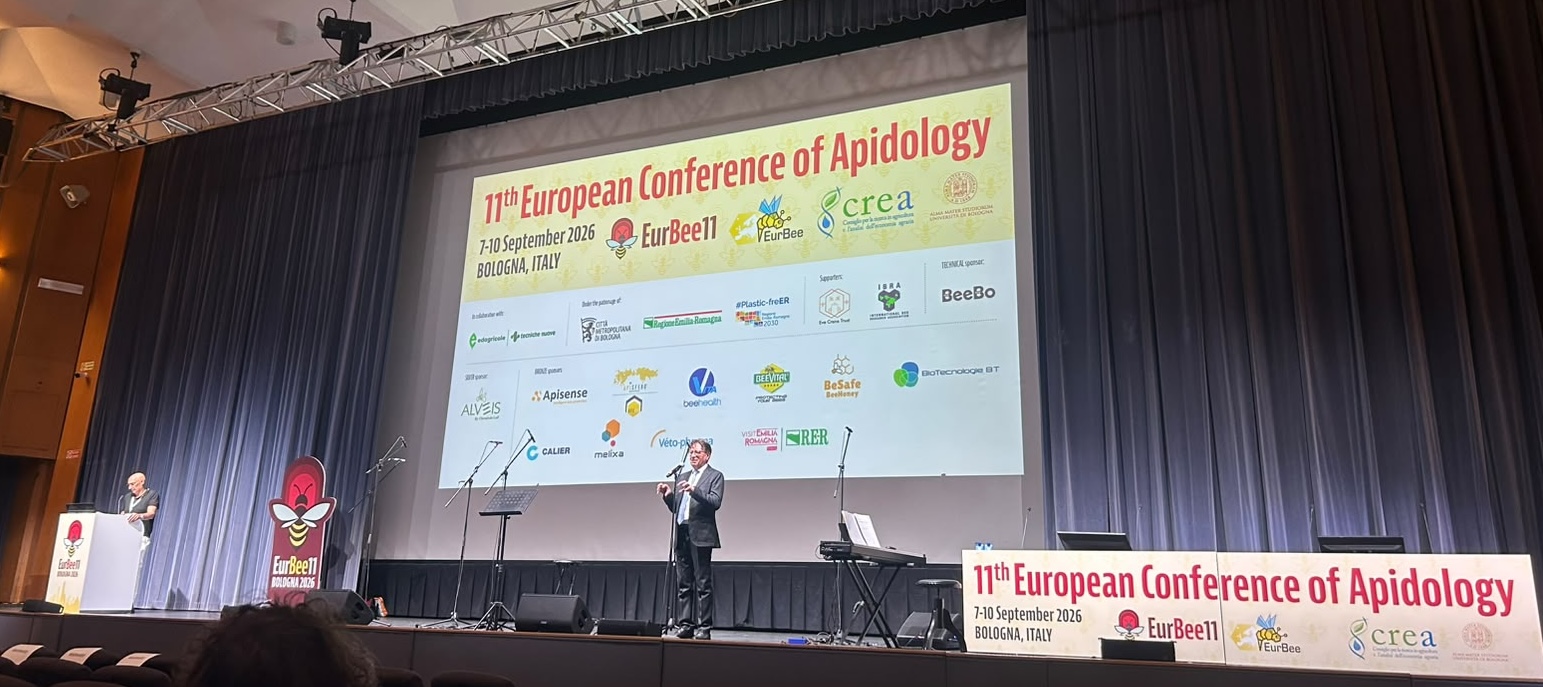
With 9 oral presentations and 10 posters Better-B is going to be extensively represented at EurBee11, the 11th European Conference of Apidology, from 7 to 10 September 2026 in Bologna, Italy.
Check out our full list of contributions below.
Oral contributions
Dirk de Graaf (UGENT) Strategic choices when the return to resilient honey bees is difficult: a conceptual note [OC37 - S7, 8 Sept, 17:00]
Gilles Verbinnen (UGENT) Characterization of candidate target-site insecticide resistance mutations in A. Mellifera [OC194 - S1, 8 Sept, 12:00]
Merel Braeckman (UGENT) Honeybee blood beyond the microscope: from morphological to marker-based classification of hemocytes [OC153 - S1, 8 Sept, 12:30]
Kamiar Torabi (UGENT) The search for genetic markers associated with thermal tolerance within several European honeybee populations [OC32, S6, 8 Sept, 16:30]
M. Alice Pinto (IPB) Are Honey Bee Subspecies Disappearing? Genome-Wide Evidence of Widespread Human-Mediated Admixture [OC96 - S3, 8 Sept, 9:45]
Raquel Martín-Hernández (IRIAF) Laboratory and proof-of-concept field studies: flupyradifurone exposure tests define a key protocol for European large-scale pesticide evaluations in bees [OC11, S12, 9 Sept, 12:15]
Fernanda Li (IPB) Landscape Genomics of Pesticide Exposure in Apis mellifera [OC87, S11, Sept 9, 12:30]
Antonio Pérez Pérez (IRIAF) A Persistent Legacy: Dynamics of Acaricide Resistance Mutations in Varroa destructor in Absence of Selection Pressure [OC95, S15, Sept 10, 10:15]
Nuno Capela (UCOI) Reducing honeybee density led to shifts in plant-pollinator interactions [OC106, S16, Sept 10, 10:15]
Posters
The posters will be on display for the full duration of the conference.
Ana Rita Lopes (IPB) Climatic Gradient Shape Wing Length Variation in European Honey Bees [P73]
Ana Rita Lopes (IBP) Mitochondrial diversity of honey bees across Europe reveals human-mediated disruption of the native lineages [P150]
Raquel Martín-Hernández (IRIAF) Beyond the pilot: the BETTER-B protocol reveals landscape-driven resilience in honey bee colonies exposed to flupyradifurone [P27]
Emmanuel Ruffio (COA) How to insulate a Dadant hive from extreme weather conditions [P71]
Optimisation: Practical Modifications Tested Within the BETTER-B Project [P65]
Séverine Kotrschal (WR) Simultaneously applying Darwinian selection for honey bee survival in 8 European countries: Insights from two years of selection [P97]
Jozef van der Steen (JVS) Better-B, beeplants.eu, a citizen scientist food source sharing study amongst pollinating insects [P76]
Demetris Taliadoros (UU) A thousand-genome panel reveals climate-adaptive variation of the western honey bee in Europe [P75]
Daniela Lima (IPB) Molecular Insights into Honey Bee Adaptation: Structural Effects of Missense SNPs in Response to Climate Change [P149]
Marco Pietropaoli (IZSLT) Performances of Selective Mechanical Traps for Autumn Control of the Invasive Hornet Vespa velutina nigrithorax in Western and Southern Europe [P204]
The next Better-B public event will take place on 25 November 2026 in Bragança, Portugal, and online. We will be holding the event in both English and Portuguese (and a little bit of Spanish).